Java 8 的 CompletableFuture
创建
- 创建一个已完成的
- 类似 guava 的 SettableFuture, 先创建一个空的,再在合适的地方完成它
- 异步计算或运行
 1
 2
 3
 4
 5
 6
 7
 8
 9
10
11
12
13
14
15
16
17
|
private static void create() {
    // 新建一个已经完成的
    CompletableFuture.<em>completedFuture</em>("");
    // JDK 9+
    // CompletableFuture.failedFuture(new Exception());

    // 类似 SettableFuture.create() 新建一个壳子
    CompletableFuture<String> hello = new CompletableFuture<>();
    // 然后在合适的时机使它完成
    hello.complete("");
    hello.completeExceptionally(new Exception());

    // 异步运行
    CompletableFuture.<em>runAsync</em>(() -> System.<em>out</em>.println("CompletableFuture<Void>"));
    // 异步计算
    CompletableFuture.<em>supplyAsync</em>(() -> "CompletableFuture<String>");
}
|
常用操作
- thenApply 完成后对类型 T 的结果执行转换为类型 U 的操作,返回新的 Future<U>
- thenAccept 完成后对类型 T 的结果执行消费操作,返回新的 Future<Void>
- thenAcceptBoth 本类型 T 和另一个类型 U 都完成后,执行消费操作,返回 Future<Void>
- thenCombine 本类型 T 联合另一个 U 都完成后,执行一个 BiFunction<T,U,V>,返回新的 Future<V>
- thenCompose 完成后的结果 T 转换为另一个 Future<U>, 类似 flatMap
- exceptionally 异常时返回兜底结果
- whenComplete 当完成或异常时的处理,返回 Future<Void>
- handle 类似 thenApply, 返回新的 Future<U>
- 各种 Async 后缀的版本:异步执行,传入线程池。不传 Executor 则默认为 ForkJoinPool.commonPool
 1
 2
 3
 4
 5
 6
 7
 8
 9
10
11
12
13
14
15
16
17
18
19
20
21
22
|
private static void then() {
  CompletableFuture.<em>completedFuture</em>("")
    // 完成后执行一个 Function 进行数据转换 类似 Stream.map
    .thenApply(String::length)
    // 联合另一个 CompletableFuture,都完成后执行一个 BiFunction 进行数据转换
    .thenCombine(CompletableFuture.<em>completedFuture</em>(1), (length, num) -> "len+num=" + length + num)
    // 当两个都完成后执行一个动作 返回新的 CompletableFuture<Void>
    .thenAcceptBoth(CompletableFuture.<em>completedFuture</em>(2), (s, num) -> System.<em>out</em>.printf("%s,%d\n", s, num))
    .thenApply(v -> "s")
    // 将完成后的结果转换为另一个 CompletableFuture 类似 Stream.flatMap
    .thenCompose(s -> CompletableFuture.<em>completedFuture</em>("compose:" + s))
    // 当出现异常时 处理异常并返回异常时的值
    .exceptionally(e -> "之前是什么类型这里就需要返回什么类型")
    // 完成后执行的动作 返回新的 CompletableFuture<Void>
    .thenAccept(System.<em>out</em>::println)
    // 类似 Accept 完成后执行的动作,返回新的 CompletableFuture<Void>
    .whenComplete((result, ex) -> {
    })
    // 类似 Apply 完成后执行的动作,返回新的 CompletableFuture<U>
    .handle((result, ex) -> "new")
  ;
}
|
后续的操作在哪个线程执行?
该 CompletableFuture 在哪个线程完成的,它之后紧接着的 then 操作就在这个线程运行。
 1
 2
 3
 4
 5
 6
 7
 8
 9
10
11
12
13
14
15
16
17
18
19
20
21
22
23
24
25
26
27
28
29
30
31
32
33
34
35
36
37
38
39
40
41
42
43
44
45
|
private static void thread() {
  CompletableFuture<String> f = new CompletableFuture<>();
  CompletableFuture<Long> other = new CompletableFuture<>();
  System.<em>out</em>.println("out: " + Thread.<em>currentThread</em>().getName());
  f
    .thenApply(s -> {
      // 这里的线程是给 f 设置结果的线程
      System.<em>out</em>.println("thenApply: " + Thread.<em>currentThread</em>().getName());
      return s;
    })
    .thenApplyAsync(s -> {
      // Async 结尾的方法不传 线程池则是 ForkJoinPoll.commonPoll
      System.<em>out</em>.println(Thread.<em>currentThread</em>().getName());
      return s;
    })
    .thenAccept(s -> {
      // 和上个操作是同一个线程
      System.<em>out</em>.println(s + " " + Thread.<em>currentThread</em>().getName());
    })
    .thenCompose(v -> other)
    .thenApply(num -> {
      // 执行线程 取决于哪个 future 后完成
      System.<em>out</em>.println(num + " .thenCompose.thenApply: " + Thread.<em>currentThread</em>().getName());
      return num + 1;
    })
  ;

  new Thread(() -> {
    // sleep(50);
    f.complete("Ha");
  }, "MyThread-1").start();

  new Thread(() -> {
    <em>sleep</em>(50);
    other.complete(1L);
  }, "MyThread-2").start();
}

private static void sleep(long mills) {
    try {
        Thread.<em>sleep</em>(mills);
    } catch (InterruptedException e) {
        e.printStackTrace();
    }
}
|
内部原理
如果是已完成的 Future, 调用各种 then 方法,就直接执行了;如果还没完成,则需要把各种 Function/Consumer 等需要执行的回调动作保存起来,待完成后再执行。
 1
 2
 3
 4
 5
 6
 7
 8
 9
10
11
12
|
private static void debug() {
  // 实际开发一般都是一条链走到底,这里为了 Debug 好对比哪个实例是哪个 故分开写变量
  CompletableFuture<String> hello = new CompletableFuture<>();
  CompletableFuture<Void> print = hello.thenAccept(System.<em>out</em>::println);
  CompletableFuture<String> upper = hello.thenApply(String::toUpperCase);
  CompletableFuture<Void> v1 = upper.thenAccept(System.<em>out</em>::println);
  CompletableFuture<Void> v2 = print.thenCombine(upper, (aVoid, s) -> s.toCharArray())
      .thenCompose(chars -> CompletableFuture.<em>completedFuture</em>(chars.length))
      .thenAccept(System.<em>out</em>::println);

  hello.complete("Hello");
}
|
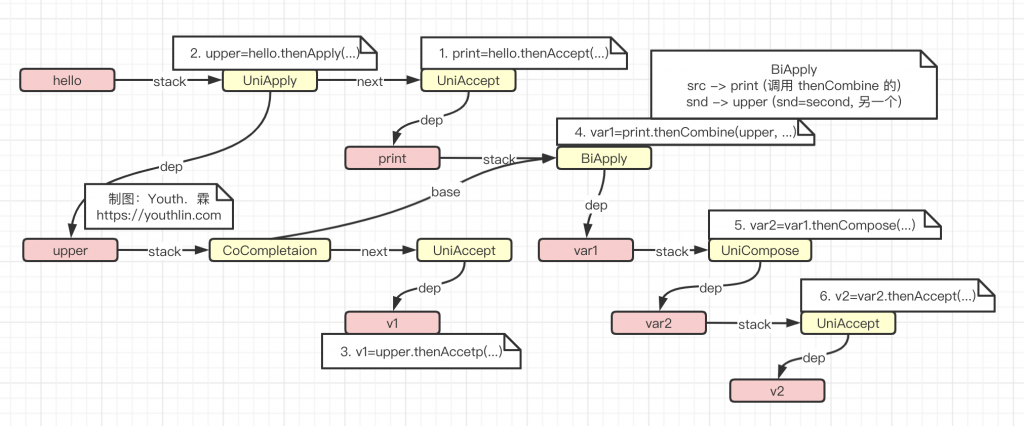 Completable 保存的回调动作
参考链接:

Reader Echoes
1 comment